Freight Transport: 5 Truths Excel Spreadsheets Hide from You
2025-09-25T16:08:33.810Z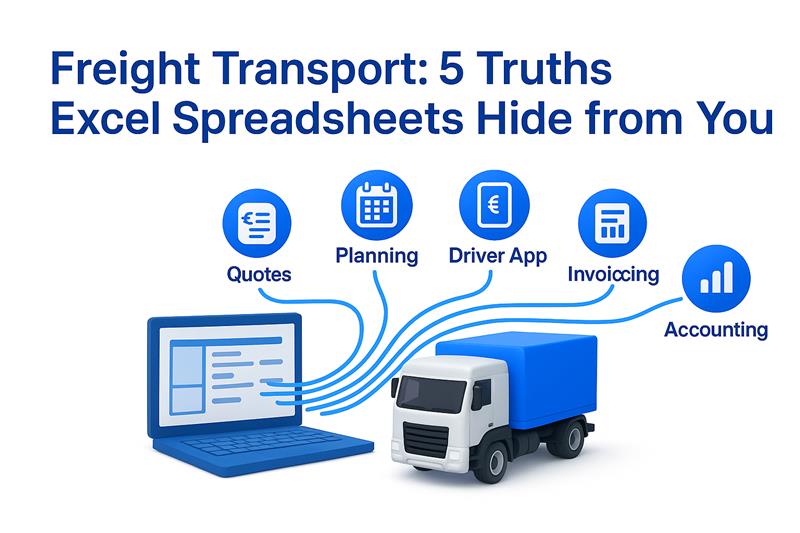
A truck at the border crossing, the CMR is ready… and suddenly, the call: the client changes the unloading location, the freight forwarder requires an additional document, the driver waits, the goods are urgent... You know what happens next: late penalties, wasted hours, and shrinking margins. But what if every step — from the quote to invoicing, including field execution — was finally synchronous and visible to everyone in real time?
1. The real problem isn’t your tools, it’s their “radio silence.”
True transformation is not about replacing one software with another, but about dismantling a set of disconnected tools. The real problem is that your quoting tool doesn’t talk to your planning system, which gets no data from the driver’s app, which is not connected to telematics or invoicing. This “radio silence” between operational silos creates chaos. The solution lies in a “vertical ERP” that unifies the entire flow, from the initial quote to final accounting. The goal is simple but radical: achieve “zero re-entry” and “zero blind spots.”
“Today, we show you how to move from a patchwork of tools to a vertical ERP that orchestrates freight transport end-to-end: a single data flow, from pricing to accounting, including field operations (missions/drivers) and telematics (GPS & tracking).”
The impact of this shift is strategic. It’s not just about connecting data; it’s about breaking silos to transform isolated data points into a continuous strategic conversation, providing coherent intelligence to steer the business.
2. The driver’s smartphone is more powerful than you think.
In a fragmented system, the driver is often a “black box on the road,” the last link in the execution chain. With an integrated mobile app, his role is redefined: he becomes the company’s main “field data sensor.” Each mission received on his phone includes the transport order, steps, documents, and even a checklist to standardize data collection. From the field, he can:
- Update statuses in real time (departure, arrival, start of loading, unloading).
- Instantly report road expenses (tolls, parking, visas).
- Capture and upload essential documents like the CMR or signed delivery note.
This change is major. Every field event instantly feeds into back-office planning, adjusts ETA estimates for the client, and, crucially, sets the stage for the next financial steps.
3. Invoicing “at the snap of a finger” is no longer fiction.
This real-time data capture by the driver is not just an operational gain; it triggers a financial revolution. As soon as a trip is closed, invoicing is no longer an end-of-month burden, but a simple validation. All the necessary data have been consolidated along the way, with no re-entry. Instantly ready are:
- The agreed tariff lines (flat rate, tonnage, ton-kilometer).
- Applicable surcharges.
- Billable expenses, already reported and justified by the driver.
The key benefit is “an accurate invoice the first time.” Strategically, this improves cash flow predictability and drastically reduces DSO (days sales outstanding), all without a hidden Excel file consolidating the data.
4. Pay your drivers’ bonuses in one click (and end disputes).
This same reliable data flow that transforms invoicing also solves another major pain point: payroll. Driver bonuses, often a source of complexity and disputes, are automatically calculated per trip based on the actual mission data.
“One click to aggregate and trigger bonuses — no more end-of-month arguments.”
This automation goes far beyond improving the social climate. For the company, it means a significant reduction in HR’s administrative workload and the elimination of a key source of operational friction and employee turnover.
5. Your data isn’t just about where the truck is, but where your money is going.
Modern GPS tracking, when integrated with an ERP, ceases to be a simple localization tool and becomes a performance management instrument. Dashboards no longer just show where the truck is; they reveal where your money is going by consolidating key performance indicators:
- Revenue by client, by tractor, by period.
- Profitability and margin per trip.
- Consolidated costs by flow (fuel, tolls, parking, visas…).
Goal: decide fast — stop trips that destroy margin, double down on those that create it.
That means moving from a monthly profitability report to the ability to identify in real time that Tuesday’s route for “Client X” systematically runs at a 2% loss due to waiting times, while Friday’s route for “Client Y” generates a 15% margin. The system gives you the intelligence to renegotiate with X and grow business with Y, directly impacting your bottom line.
The end of chaos
Abandoning a fragmented system in favor of a unique, end-to-end data flow without breaks is not just a tech update; it’s a strategic overhaul of your operations. The result is a more agile, more transparent, and more profitable company, with “fewer surprises, fewer hidden costs, faster cash.”
And you — if you had a perfectly unified view of your operations, what’s the first decision you’d make to improve your margin?