TCO 2.0: How to Predict Your Costs Before They Happen Thanks to Real-World Fleet Data
2025-11-27T17:39:43.591Z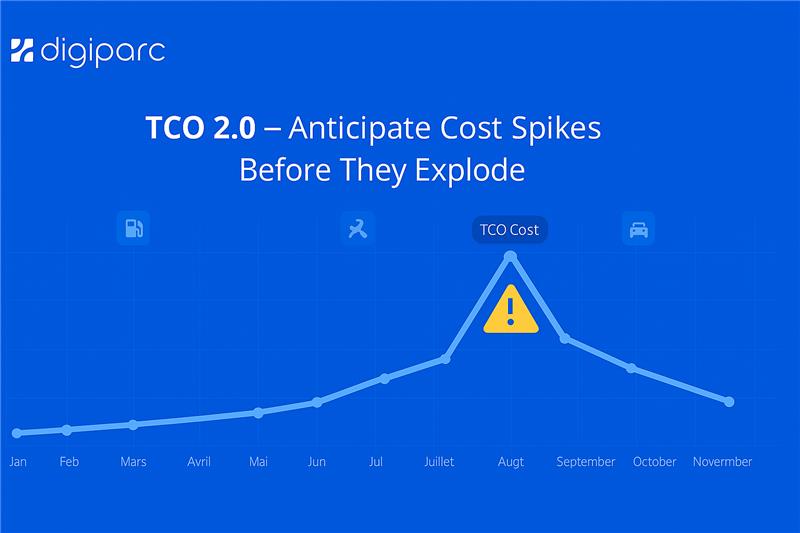
Fleet management is evolving fast. While TCO — Total Cost of Ownership — used to be calculated once a year in an Excel sheet, it has now become a real-time strategic tool capable of predicting budget overruns before they even occur.
Welcome to the era of TCO 2.0.
1. Why Traditional TCO Is No Longer Enough
For years, fleet managers relied on a theoretical TCO based on:
- ⬝ average fuel consumption,
- ⬝ approximate maintenance forecasts,
- ⬝ estimated costs,
- ⬝ year-end consolidated invoices.
This model presents several issues:
- ⬝ It doesn’t reflect the real usage of vehicles.
- ⬝ It fails to detect gradual drifts (overconsumption, accelerated wear, incidents).
- ⬝ It makes it difficult to identify when a vehicle becomes too expensive.
- ⬝ It provides a static view, even though a fleet evolves and deteriorates day after day.
As a result:
👉 Budget overruns come as a surprise.
👉 Replacement decisions are made “by intuition.”
👉 Thousands of euros can quietly disappear without anyone noticing.
2. TCO 2.0: A Living Indicator That Reflects the Reality of Your Fleet
Modern TCO is no longer just the sum of your expenses.
It’s an intelligent dashboard, powered directly by real-world fleet data.
Key data in a dynamic TCO:
- ⬝ Fuel: actual consumption, model discrepancies, driving behavior
- ⬝ Maintenance: history, cost per breakdown type, recurrence, drift
- ⬝ Actual mileage: planned vs. actual distance
- ⬝ Incidents & safety: collisions, harsh braking, aggressive driving
- ⬝ Depreciation based on real usage rather than catalog value
What this changes:
- ⬝ You can identify vehicles that are too costly in real time.
- ⬝ You anticipate cost spikes at 1, 3, or 6 months.
- ⬝ You know exactly when to replace a vehicle before it becomes a financial burden.
- ⬝ You optimize purchases, maintenance activity, and route planning.
TCO 2.0 is no longer a number.
➡️ It’s the financial thermometer of your fleet.
3. AI: The Engine Behind Predictive TCO
While traditional TCO looks at the past, TCO 2.0 looks at the future.
Thanks to artificial intelligence, it’s now possible to:
- ⬝ spot anomalies invisible to the human eye,
- ⬝ predict the next likely breakdowns,
- ⬝ estimate future costs for each vehicle,
- ⬝ simulate multiple budget scenarios.
AI analyzes:
- ⬝ consumption trends,
- ⬝ maintenance frequency,
- ⬝ part wear,
- ⬝ risky driver behavior,
- ⬝ breakdown patterns.
It can then tell you:
- ⬝ “This vehicle will cost 12% more next month.”
- ⬝ “Optimal replacement is in 4 months.”
- ⬝ “The abnormal consumption comes from chronic under-inflation.”
- ⬝ “A battery failure is likely within 3 weeks.”
👉 This shift from reactive to predictive generates massive savings.
4. Real-World Example
A fleet of 40 vehicles records a progressive increase in fuel consumption.
In Excel, the discrepancy would only appear at the end of the year.
With a dynamic TCO:
- ⬝ The system detects a 9% overconsumption on 12 vehicles.
- ⬝ AI identifies the causes:
- ⬝ under-inflated tires
- ⬝ aggressive driving from 3 drivers
- ⬝ air filters not replaced on 5 vehicles
After correction:
➡️ €11,800 saved in just 6 months.
This is the real power of TCO 2.0.
5. How Digiparc Turns TCO Into a Competitive Advantage
Digiparc enables fleet managers to shift from theoretical TCO to intelligent TCO:
- 📍 Real-time TCO dashboard
- 🚨 Automatic alerts when costs drift
- 🔧 Preventive & predictive maintenance
- 🔍 Advanced analysis of fuel, wear, incidents
- 📈 Budget simulation & scenario planning
- 🕒 Optimized replacement decisions before costs escalate
You no longer wait for bad news:
➡️ You prevent it.
Conclusion: TCO 2.0 Is the New Superpower of Fleet Managers
Fleet managers relying on a static TCO operate with limited visibility.
Those who embrace dynamic and predictive TCO:
- ⬝ reduce their costs,
- ⬝ extend the useful life of their vehicles,
- ⬝ make faster and more accurate decisions,
- ⬝ secure their budgets,
- ⬝ and boost their fleet’s overall performance.
👉 TCO is no longer just a financial calculation.
👉 It’s a strategic lever.