Companies, especially small ones, tend to consider fleet management. as a trivial task. It becomes increasingly cumbersome and time-consuming when the company seeks savings on its fixed costs or when the size of the vehicle fleet increases or the company expands over several sites. Naturally at this stage, the question arises as to which tool is best suited for fleet management.
Since most companies and their employees are familiar with Excel and it is therefore much easier to build work tools in familiar software than to introduce new software, most companies choose it to track their vehicle fleet.
Indeed, managing a fleet with Excel allows you to list most of the important information. Generally, managers have an Excel file for registration documents, another for claims, fuel, taxation, etc.
However, many companies experience real nightmares with this tool. If Excel allows a certain flexibility and has remarkable functionalities, if used incorrectly, it can introduce considerable administrative burden and make any user cry. Just think of broken formulas, calculation errors that lead to decisions based on bad information, etc.
For example, in2012 JP Morgan, the large American financial holding company, lost9 billionnet dollars due to the disappearance of an Excel document; handling a multitude of spreadsheets and files, necessarily completed by hand, by a non-automated process, would have generated fatal errors for the company.
Certainly, the Excel spreadsheet continues to be very successful whenever a systematic fleet management tool is necessary. But he is criticized for many things for being able to trust him completely with the management of a large fleet.
What we criticize about Excel:
- Lack of structure: The software is used in so many ways that maintaining it is very difficult;
-
- High risk of error: Excel is a tool without automation and without self-checking; excessive use of copy/paste functions, from one spreadsheet to another, increases the risk of error. The possibility of human errors during manual transcriptions and formatting changes also exists (0.8% à 1.8%). An error in an equation can be fatal;
-
- Waste of time: Programming, formatting, reorganizing formulas and functions, testing programming represent a huge, real waste of time.
-
- Rigidity: Spreadsheets are not adapted to the specific requirements of a business, procedural changes and the complexity of the transactions to be programmed;
-
- Collaborative work: Relying solely on Excel makes collaboration and tracking changes very difficult.
-
- Difficulty: Difficulty generating new reports dynamically. Spreadsheets quickly become unreliable and complicated to operate and maintain.
Consequently, it would be difficult to follow with an Excel file the dynamic information of fleet management: updating of the last mileages, actual vehicle costs, actual fuel consumption ratios, logging of contractual rental modifications, etc.
With ever more numerous positions to manage (fuel, maintenance or driving), a more sophisticated tool is essential.
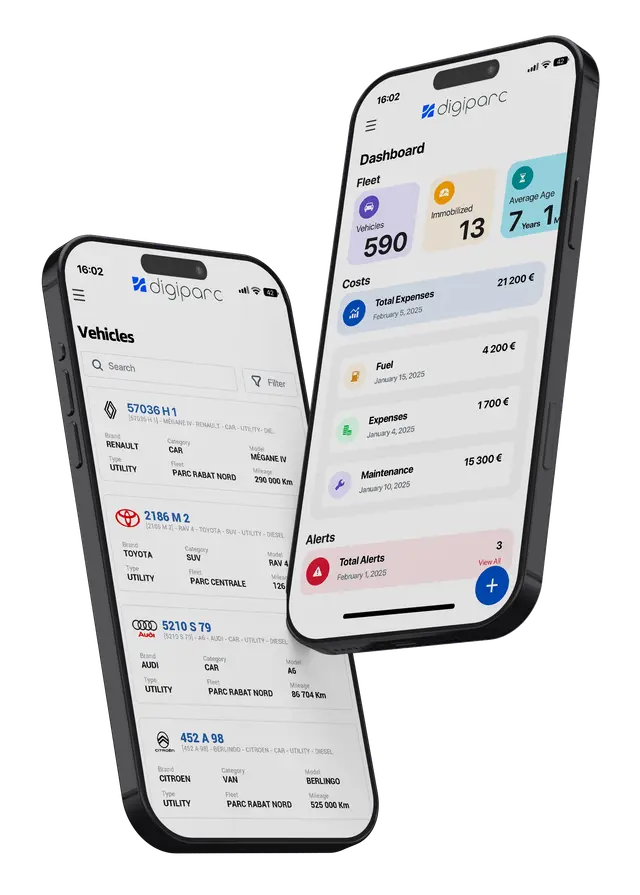
DIGIPARC, a fleet management software package, will enable fleet managers to significantly increase productivity and save significant amounts through better management of contracts, better control of invoices and precise, real-time monitoring of the fleet.
With the richness of its functionalities, the simplicity of its use, the user-friendliness of its interface, its attractive pricing offer, the responsiveness of its team, the quality of the advice and assistance service offered and, finally, thanks to the credibility of its publisher (number of vehicles already managed, experience, seniority of the publisher), DIGIPARC brings significant and real advantages to companies.
Indeed, it optimizes their management processes (economic and financial flows), homogenizes their information and gives it consistency (a single item file, a single customer file, etc.), promotes compliance with standards, unifies their information systems, optimizes internal communication and employee mobility, optimizes productivity, centralizes control of the car fleet. and aids in rapid decision-making.