Published June 5, 2017
Automotive fleet management: why will big data become a strategic issue?

Today, automobile fleet management software is essentially used to manage vehicles individually as well as the events associated with them. This micro management of each vehicle with its associated driver(s) allows the manager to monitor his fleet on a daily basis.
On the other hand, the macro analysis of the data generated by all the parks remains quite limited. And yet, millions of extremely useful data are now produced by vehicle fleets:
- Basic data recorded in the management system:events linked to the vehicle, or to the drivers, fixed charges and variable charges, etc.
- Data recorded by on-board systems such as OBD (On Board Diagnostic):mileage, consumption, maintenance, alerts…
- Embedded IOT (Internet Of Things):more and more connected objects are present in vehicles and also send data
- And finally the APIs (Application Programming Interface) which make it possible to retrieve data from the company's partners: Total GR, leasing companies, Sage for accounting for example, etc.
Why is this data so strategic for the fleet manager?
In fact, this data will bring out major trends which will allow him to carry out his job differently: in fact, instead of being subject to events, the fleet manager will be able to increasingly adopt a predictive logic in order to better rationalize the management of his fleet:
- Pro active maintenance:faced with recurring breakdowns, the manager will be able to define new processes and make appropriate decisions by involving the stakeholders concerned, in particular the drivers and the dealer for example.
- Controlled consumption:In the long term, he will be able to generally compare his actual consumption with that displayed by the manufacturer and thus analyze the reasons for the differentials.
- Comparison between fleets or between driver typologies:immediately the differences in measurements will allow it to identify the behaviors on which to act as a priority in order to improve the fundamentals of its fleet: driving style, management of costs, fines, etc.
Une nouvelle vision du fleet management :
By benchmarking the fundamentals of its fleet more systematically, the manager can find relationships and corrections between different factors. These new indicators also give it a new vision of its profession which will thus be increasingly focused on predictive management.
The essential issues of big data integrated into its business being:
- Reduce vehicle downtime
- To improve ROI and TCO
- To make structural savings on important items such as fuel or tires
Digiparc, a big data-oriented fleet management solution:
But the greatest danger with big data is the data itself and its galloping inflation which, uncontrolled, can render any attempt at interpretation ineffective.
Fundamentally, Digiparc is structured to perfectly meet these challenges. Indeed, the logic of strong separation between the repository and the operational, makes it possible to generate data that is easy to exploit and analyze.
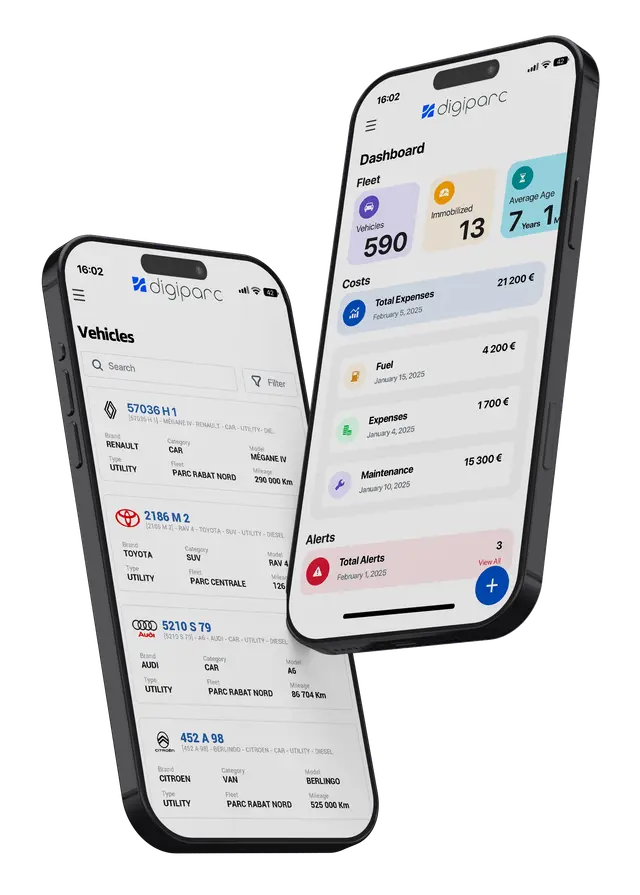
Thanks to an approach focused on reporting (more than 50 types of reports available), Digiparc also offers the possibility of cross-referencing data in all directions and on your main centers of interest.
Furthermore, the systematization of alerts allows the manager to rely on a robust system for predictive interpretation of the data.
Finally, with the new version 5.0 of Digiparc, the dashboards are now present for everyone new to the interface and allow you to have a global vision of the situation of your park at any time.
To conclude, the big data revolution in the world of fleet management is only just beginning!
Olivier LOMBART
Business Development Manager France